- Home
- Cruising Yachts 40' to 45'
- Island Packet 40
The Island Packet 40 Sailboat
Specs, Performance Analysis & Cruising Characteristics
Key Takeaways
The Island Packet 40 is a quintessential heavy-displacement cruiser designed for long-distance voyaging and liveaboard comfort. It is defined by its full-foil keel, which provides exceptional directional stability and protects the rudder and propeller, though this comes at the cost of a larger turning circle and slower speeds in light air. Its high ballast-to-displacement ratio and impressive motion comfort make it a safe, predictable platform for offshore passages, even if it lacks the "point-and-shoot" agility of modern fin-keeled alternatives.
Design & Construction
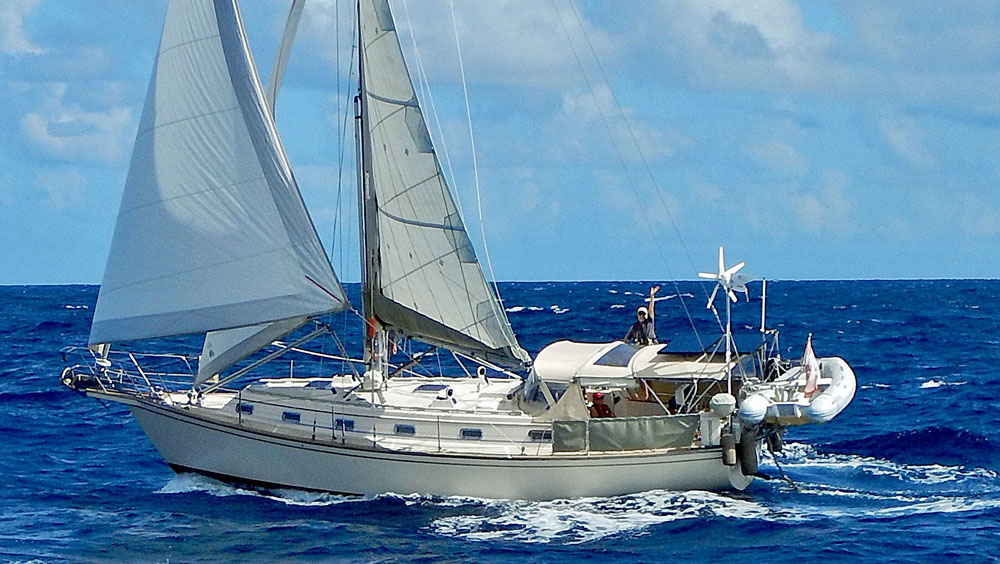
Designed by Bob Johnson and built by Island Packet Yachts in Florida, the Island Packet 40 represents a high-water mark for the company during its production run from 1992 to 2000. Constructed from solid glass reinforced plastic (GRP) with a proprietary "PolyClad" gelcoat system to resist osmosis, the hull is engineered for immense strength. Unlike many contemporary designs that opt for bolt-on fin keels, the IP40 features a one-piece integrated hull and keel.
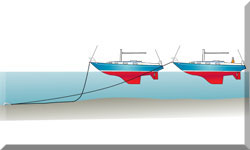
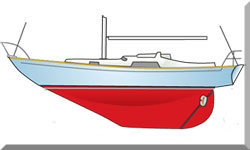
The defining feature of this vessel is the Full Foil Keel. This design encapsulates the ballast within the hull structure and provides a long, stable footprint in the water. Practically, this means the boat resists "hunting" in a following sea and can be grounded safely without complex support. It also creates a massive structural grid that contributes to the boat's legendary reputation for toughness.
 IP40 Sailplan & Accommodation Layout
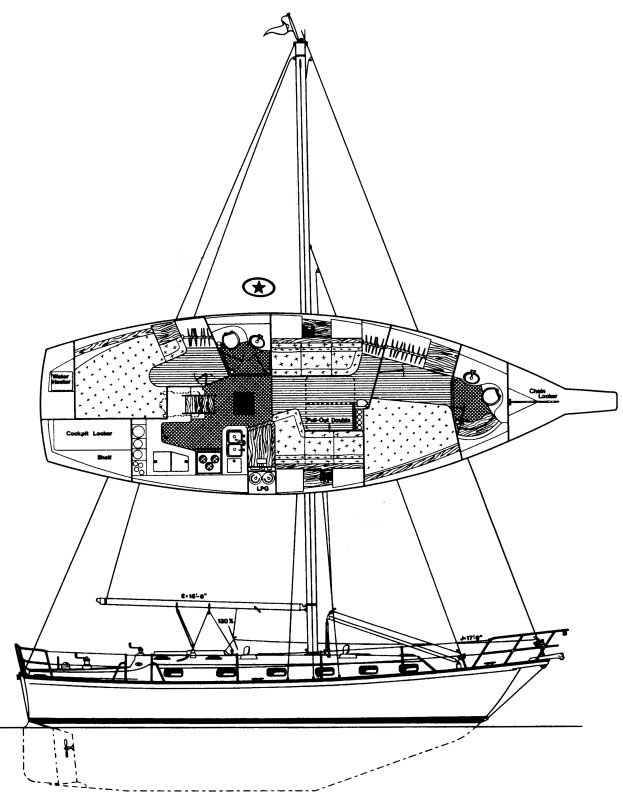
While the Island Packet 40 stayed true to its cutter-rigged, full-keel DNA throughout its life, it was an evolution of the earlier IP38, offering more waterline length and a more refined interior. A notable layout departure from its predecessor is the adoption of the Pullman-style berth in the forward cabin. This arrangement places the large double bed against the side of the hull rather than in the "V" of the bow, allowing for a much larger private head and shower compartment right in the forepeak. Most models featured the signature geared rack-and-pinion steering and a staysail on a Hoyt boom, which simplifies tacking and improves sail shape for shorthanded crews.
Sail Areas & Rig Dimensions
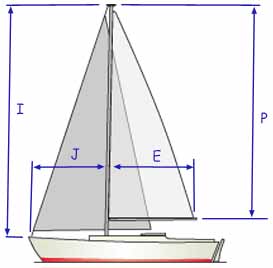 Rig dimensions
The IP40 is a versatile cutter, allowing for various sail combinations depending on wind strength. The factory rig dimensions are as follows:
- Total Sail Area: 932 ft² (86.58 m²)
- Mainsail Area: 346 ft² (32.14 m²)
- 100% Foretriangle: 455 ft² (42.27 m²)
- I (Mast Height): 50'10" (15.50 m)
- J (Foredeck Length): 17'10" (5.44 m)
- P (Mainsail Luff): 44'0" (13.41 m)
- E (Mainsail Foot): 15'9" (4.80 m)
Published Specification:
| Feature | Specification & Data |
|---|---|
| LOA (Length Overall) | 41'6" (12.65 m) |
| LWL (Length Waterline) | 34'0" (10.36 m) |
| Beam | 12'11" (3.94 m) |
| Draft | 4'8" (1.42 m) |
| Displacement | 22,800 lbs (10,342 kg) |
| Ballast (Lead) | 10,000 lbs (4,536 kg) |
| Rig Type | Cutter |
| Hull Material | GRP (Fibreglass) |
| Production Dates | 1992 – 2000 |
Performance Analysis: Understanding the Design Ratios
To truly understand how this boat behaves in the open ocean, we look at the mathematical relationships between its weight, length, and sail power. These figures provide a objective look at the "Island Packet crawl" versus its "heavy-weather stamina." For a deeper look at the theory behind these numbers, see our article on Understanding Boat Performance & Design Ratios.
| Ratio | Value | Interpretation |
|---|---|---|
| SA/D (Sail Area & Displacement) | 18.57 | Moderate for a cruiser. It has enough power to move in a breeze but will feel sluggish in light air without a reacher. |
| D/L (Displacement & Length) | 258.6 | Classified as a medium-heavy displacement cruiser. This indicates high load-carrying capacity and a steady motion. |
| B/D (Ballast & Displacement) | 43.8% | Exceedingly high. This provides a massive margin of safety and stiffness, allowing the boat to carry sail longer. |
| CSF (Capsize Screening Formula) | 1.81 | Well below the 2.0 safety threshold. This is a very safe offshore boat with a low risk of inversion. |
| Brewer Motion Comfort Ratio | 34.42 | High. This boat will not "toss" its occupants around. It provides a predictable, easy-going ride in a seaway. |
Structural Integrity & Stability Dynamics
Because the GRP hull is thick and the ballast is internal, there are no keel bolts to fail or leak. This makes the boat inherently safer for those navigating poorly charted waters or areas with debris. Unlike aluminium boats that require strict galvanic monitoring, the GRP construction is relatively low maintenance, though one must still watch for the occasional "crazying" in the gelcoat.
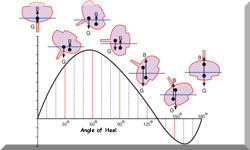
The full keel impacts stability by creating a very deep "righting moment" (Gz) curve. While a modern fin-keeled boat might have more initial "snap" stability, the IP40 feels more like a pendulum. It heels to a certain point and then simply stays there, solid and unbothered. The downside is increased wetted surface area, which creates drag, but for the blue-water sailor, the trade-off for a boat that tracks like it is on rails is usually worth it.
Configuration, Layout & Cruising Characteristics
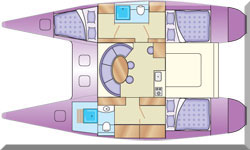
The Island Packet 40 was built for people who actually live on their boats. The interior is spacious, making use of the generous 12'11" beam. The galley is a secure, U-shaped affair located to starboard, designed to be used safely while the boat is heeling. Storage is abundant, with lockers tucked into every available corner.
- Tankage: The boat carries approximately 170 gallons (643 litres) of water and 90 gallons (340 litres) of fuel. For a 40-foot boat, this is exceptional and allows for long periods of self-sufficiency.
- Cockpit Function: The cockpit is deep and well-protected. While some modern sailors might describe it as "snug," it is a safe place to be when the weather turns foul. The high coamings provide excellent back support.
- Draft: At only 4'8", the IP40 can go where many other 40-footers cannot. It is as much at home in the Bahamas as it is in the North Atlantic.
Impressed?

Has this article suggested that this could be your ideal cruising boat and, as a result, deserves to be on your "Worth a Look" list?
But if, like me, you find sailboats to be seductive creations, then that list could rapidly get to be a pretty long one. If that is the case, wouldn't it be good if you could narrow it down bit through an objective, pragmatic process?
Well, that's where my eBook 'How to Avoid Buying the Wrong Sailboat' comes in...
Summing Up
The Island Packet 40 is not a boat for those in a hurry or those who enjoy the thrill of a light-wind regatta. Its design ratios and full-keel configuration confirm its identity as a purposeful, heavy-duty cruiser. While the high wetted surface area and displacement make it slower in light conditions, these same traits offer a level of comfort and safety at sea that few modern production boats can match. For the pragmatic sailor who values structural integrity, massive tankage, and a forgiving motion over outright speed, the IP40 remains one of the most respected choices on the second-hand market.
If you'd like to compare this boat with others in this size range, take a look at Cruising Boats from 40' to 45' overall....
This article was written by Dick McClary, RYA Yachtmaster and author of the RYA publications 'Offshore Sailing' and 'Fishing Afloat', member of The Yachting Journalists Association (YJA), and erstwhile member of the Ocean Cruising Club (OCC).
Frequently Asked Questions (FAQs)
How does the Island Packet 40 handle in tight marinas given its full keel?
How does the Island Packet 40 handle in tight marinas given its full keel?
Handling a full-keeled boat in reverse is an acquired skill. The IP40 does not have the "prop walk" predictability of a fin keel and will largely go where the wind and current dictate when moving backwards. Many owners find a bow thruster to be a worthwhile investment for stress-free docking.
Is the chainplate issue a real concern on the IP40?
Is the chainplate issue a real concern on the IP40?
Yes, like many Island Packets of this era, the chainplates are encased in fibreglass. Over decades, water can seep in and cause crevice corrosion. If they have not been replaced or inspected in the last 20 years, this should be a primary concern during a pre-purchase survey.
Can the Island Packet 40 be sailed effectively by a solo sailor?
Can the Island Packet 40 be sailed effectively by a solo sailor?
Absolutely. The cutter rig, combined with the Hoyt boom on the staysail, makes the boat very easy to manage. Most lines lead back to the cockpit, and the boat's inherent directional stability allows the autopilot to work less hard than on a flighty fin-keeled boat.
What is the expected cruising speed under power?
What is the expected cruising speed under power?
Equipped with the standard 50hp Yanmar, you can expect a comfortable cruising speed of about 6 to 6.5 knots at 2,400 RPM. Pushing it harder will mostly just increase noise and fuel consumption due to the hull's displacement limitations.
How does the "PolyClad" hull hold up against osmosis?
How does the "PolyClad" hull hold up against osmosis?
Island Packet offered a ten-year warranty on these hulls for a reason. The PolyClad system has proven to be very effective, and while no GRP boat is entirely immune to moisture, the IP40 has a much lower incidence of blistering than many of its contemporaries.
Recent Articles


-
Best PLBs for Sailors in 2026 — Top Personal Locator Beacons Reviewed
Sep 26, 26 05:54 PM
Discover the best PLBs for sailors in 2026. Compact, reliable personal locator beacons ideal for man‑overboard emergencies and offshore cruising. -
Best AIS Systems for Cruising Sailboats 2026 — Class B & B+ Guide
Sep 25, 26 05:20 PM
Find the best AIS systems for cruising sailboats in 2026. Clear guidance on Class B vs Class B+, transceivers vs receivers, NMEA 2000 compatibility, and top AIS units available on Amazon. -
Comparing Handheld VHF Radios
Sep 25, 26 04:38 PM
Budget, Mid-Range and Premium VHF Radios functionality and performance compared